

The Android tablet market is shifting rapidly. Manufacturers now target professionals and students instead of just media viewers. The OnePlus Pad 4 and Xiaomi Pad 8 lead this new charge. Both brands offer hardware designed to replace traditional laptops.
We spent days researching these tablets. We have researched the performance, display, battery performance, and gaming reviews.
One is a powerhouse; the other is a bargain. We will show you where your money actually goes. Our breakdown reveals which tablet truly deserves your investment.
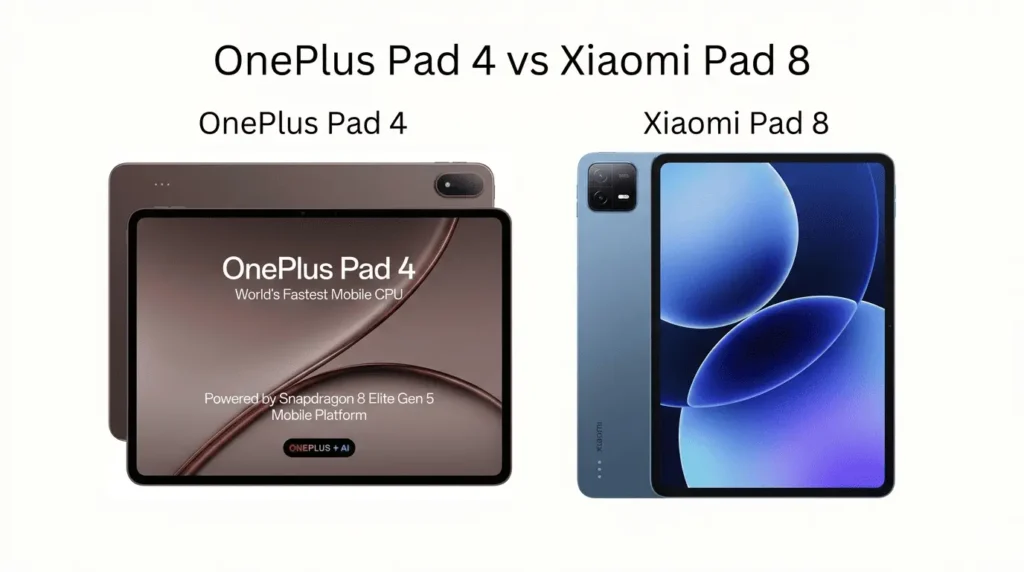
Quick Comparison: At a Glance
| Feature | OnePlus Pad 4 | Xiaomi Pad 8 | Winner |
| Display (Size/Res) | 13.2-inch 3.4K LCD | 11.2-inch 3.2K LCD | OnePlus Pad 4 |
| Processor | Snapdragon 8 Elite | Snapdragon 8s Gen 4 | OnePlus Pad 4 |
| RAM & Storage | Up to 12GB / 512GB | Up to 12GB / 256GB | OnePlus Pad 4 |
| Battery & Charging | 13,380mAh / 80W | 9,200mAh / 45W | OnePlus Pad 4 |
| Camera (Rear/Front) | 13MP / 8MP | 13MP / 8MP | Tie |
| Operating System | OxygenOS 16 | HyperOS 3 | OnePlus Pad 4 |
| Stylus Support | Stylo Pro (16K levels) | Focus Pen | OnePlus Pad 4 |
| Keyboard Support | Smart Keyboard | Floating Keyboard | Tie |
| Build & Weight | 672g / 5.9mm thin | 485g / 5.75mm thin | Xiaomi Pad 8 |
| Price (Starting) | ₹59,999 | ₹33,999 | Xiaomi Pad 8 |
Display & Design: Screen Quality and Portability
Aspect ratio defines your daily tablet experience. Taller screens suit documents, while wider screens fit movies. Your choice depends on your specific work style.
OnePlus Pad 4
The OnePlus features a massive 13.2-inch 3.4K panel. Its unique 7:5 aspect ratio provides a “book-like” feel. This design adds significant vertical space for reading. The Dune Glow finish feels premium and resists most smudges. Its 5.9 mm profile is remarkably thin for such a large device.
Xiaomi Pad 8
Xiaomi chooses a more portable 11.2-inch display. The 3:2 aspect ratio feels traditional and compact. It weighs just 485g, making it easy to hold. It’s suitable for one-handed use, best for reading and browsing without fatigue. It also offers an optional nano-texture coating to reduce glare.
The OnePlus offers superior space for split-screen productivity. The Xiaomi wins on portability for travelers and students. Good screens provide the view, but hardware determines the speed.
Performance & Daily Use: Real-World Speed
A strategic gap now exists between flagship and mid-range tablet silicon. One device seeks maximum power. The other balances performance with cost.
The Processing Gap
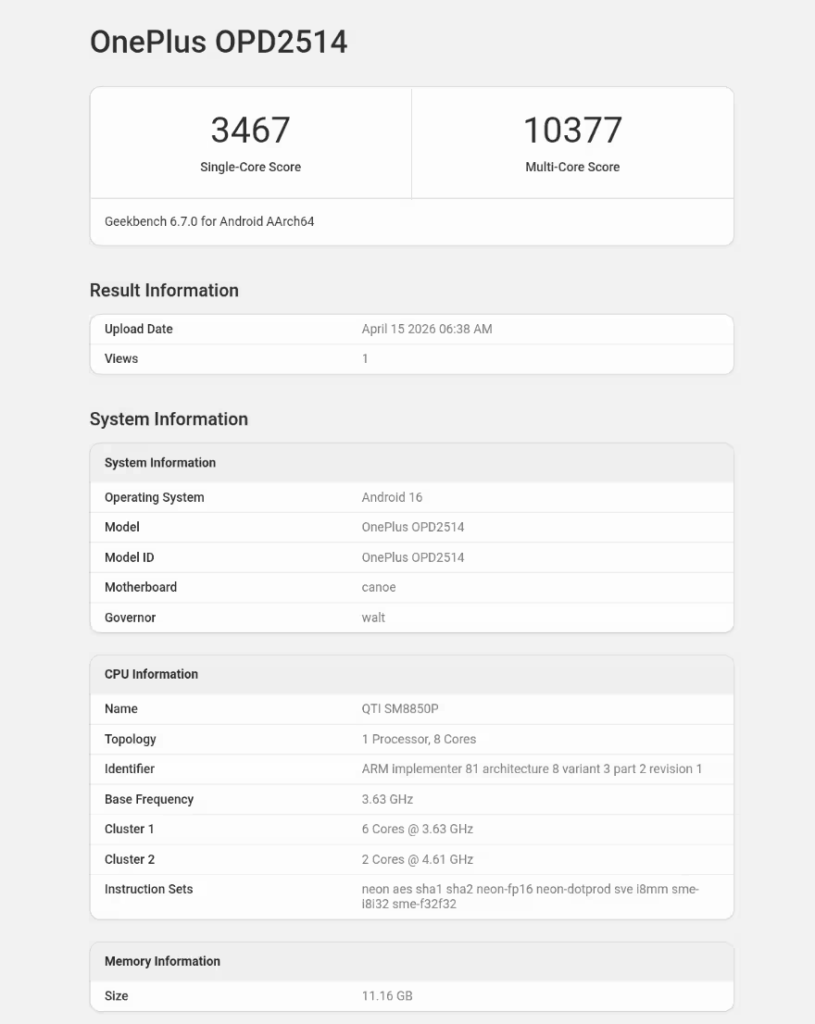
OnePlus uses the flagship Snapdragon 8 Elite Gen 5 chipset. Xiaomi uses the Snapdragon 8s Gen 4. The “s” suffix denotes a stripped-down, mid-range architecture. OnePlus registered 3,467 single-core and 10,377 multi-core points on Geekbench. These scores lead the market.
Multitasking & Gaming
The OnePlus can handle Genshin Impact at max settings with ease. It stays cool during long sessions. The Xiaomi Pad 8 is sufficient for most tasks. However, it trails in raw frames per second during heavy gaming. It sometimes struggles with high-end optimization in demanding titles.
OnePlus uses fast UFS 4.1 storage across all models. Xiaomi uses a mix of UFS 3.1 and 4.1. The OnePlus is a future-proof choice for video editing. High performance requires significant power, leading to our battery tests.
Battery Life & Charging: Endurance Testing
Battery capacity is the unsung hero for mobile professionals. A dead tablet fails as a laptop replacement.
Analysis
The OnePlus Pad 4 packs a massive 13,380mAh battery. It outlasts Xiaomi’s 9,200mAh. The battery backup on OnePlus can last a full day and a half. The Xiaomi usually requires a charge every night.
Charging Speed
OnePlus supports 80W SuperVOOC charging. Xiaomi tops out at 45W. The OnePlus refills to 100% in about 94 minutes. This speed is vital for such a large battery.
The OnePlus endurance makes it a reliable primary work machine. You can finish long flights without a power outlet. The Xiaomi is decent but lacks the stamina for heavy workdays.
Camera & Audio Experience: Practical Use
Tablet cameras are now essential for video calls and scanning. They are no longer simple afterthoughts.
Camera Quality
Both tablets use a 13MP rear and 8MP front setup. These sensors work well for scanning documents and Zoom calls. Neither device replaces a flagship smartphone for photography. They handle professional communication tasks with reliability.
Audio Performance
OnePlus includes a symmetrical 8-speaker setup. It delivers rich and immersive sound. Xiaomi uses a 4-speaker system. We found that the Xiaomi speakers are a regression from the Pad 7 series. Xiaomi quietly used cheaper components in this generation.
The OnePlus is the superior choice for professional meetings and movies. Its 8-speaker array creates a wide, clear soundstage. Hardware power relies on software to tie it all together.
Software & Features: OxygenOS vs. HyperOS
Tablets require optimized software to be useful. Standard mobile interfaces often fail on large screens.
OxygenOS 16 (OnePlus)
OnePlus includes the excellent Open Canvas system. It handles 3 active tiled windows and 2 floating windows simultaneously. This system feels intuitive and very desktop-like. It syncs notifications and clipboards seamlessly with OnePlus phones.
HyperOS 3 (Xiaomi)
Xiaomi’s HyperOS 3 focuses on the broader IoT ecosystem. It features HyperAI tools for text summarization and writing. It lacks the deep multitasking focus found in OxygenOS. The interface feels more like a large phone than a workstation.
OxygenOS 16 is more intuitive for professionals managing multiple tasks. It transforms the tablet into a capable mobile office. Physical tools unlock these software features.
Accessories: Stylus & Keyboard Productivity
Accessories transform a simple media slab into a laptop. They are essential for serious work.
OnePlus Stylo Pro & Keyboard
The Stylo Pro offers 16,000 levels of pressure sensitivity. It provides haptic feedback that mimics a pen on paper. The Smart Keyboard features a high-quality trackpad for easy navigation. Typing feels crisp and comfortable for long documents.
Xiaomi Focus Pen & Keyboard
The Xiaomi Focus Pen excels at handwriting detection. Xiaomi offers a magnetic floating keyboard that mimics the iPad. This setup is stable but adds significant weight. It creates a solid “mini laptop” feel at a lower price.
The OnePlus setup suits creative professionals needing advanced haptic tools. The Xiaomi setup is great for students on a budget. However, the OnePlus stylus feels more natural for drawing.
Value for Money: The Price-to-Performance Ratio
A ₹26,000 price gap separates these two tablets. Buyers must weigh the cost against their actual needs.
Evaluation
The OnePlus Pad 4 starts at ₹59,999. It is a premium flagship for power users. The Xiaomi Pad 8 costs just ₹33,999. This massive savings could buy a mid-range phone or many accessories.
The flagship chip and massive battery justify the OnePlus price. However, Xiaomi offers 80% of the experience for nearly half the cost. Most casual users will find that Xiaomi provides better value.
Final Verdict: Who Should Buy Which?
Choose the OnePlus Pad 4 if you are:
- A power user needing the Snapdragon 8 Elite for editing or gaming.
- A creative professional who wants a stylus with 16,000 pressure levels.
- A worker needing a laptop replacement with Open Canvas multitasking.
Choose the Xiaomi Pad 8 if you are:
- A budget-conscious student using the device for notes and research.
- A casual media consumer who wants a light, portable screen.
- A buyer seeking a “mini laptop” feel without paying flagship prices.
Final Recommendation: The OnePlus Pad 4 is our decisive choice for the best high-performance Android tablet.